
Contents
Resources from Recent Trends in Sexual Choking
Tess Zachary, National Coalition for Sexual Freedom, Tess@NCSFreedom.org
The topic of sexual choking is increasingly appearing in the media and in peer-reviewed journals, documenting a rise in engagement in sexual choking, particularly by young adults, and the associated physical/psychological effects that come with choking. We will discuss these findings along with NCSF’s research on the kink communities’ negative attitudes toward choking, and the number of deaths that have occurred in the U.S. due to sexual choking. We will also discuss incident reports that NCSF has received about sexual choking, documenting the rise in nonconsensual choking that is occurring and the consequent liability risks people are facing. Harm reduction alternatives will be included so educators can offer safer alternatives for those who enjoy the feeling of power/control or the physical rush that occurs with choking, without involving the ultrahazardous risk of strangulation.
Recent Trends in Sexual Choking Poster
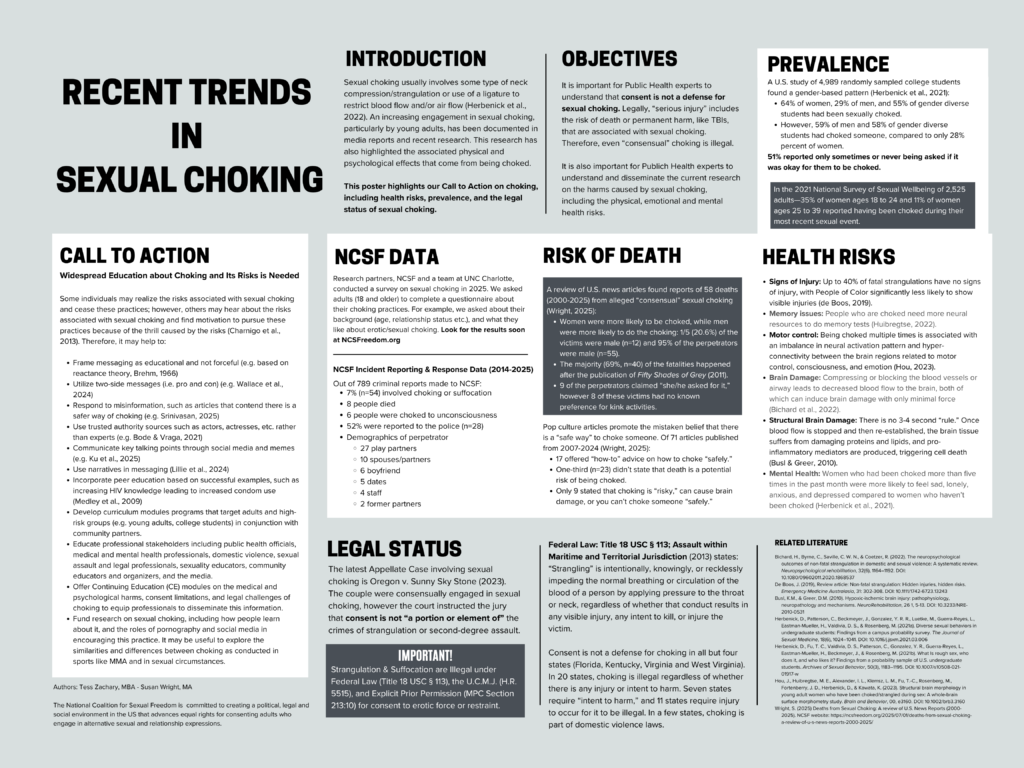
This poster highlights our Call to Action on choking, including health risks, prevalence, and the legal status of sexual choking. Sexual choking usually involves some type of neck compression/strangulation or use of a ligature to restrict blood flow and/or air flow (Herbenick et al., 2022).
The popularity of sexual choking has grown rapidly in the past several years among adults under the age of 40. In 2021, a campus-representative survey of over 4,200 University students found that most of the choking participants (88.9%) understand that people can die from being choked during sex, yet 37.5% said choking was safe and half (49.6%) reported that they knew
how to engage in choking safely (Herbenick, 2024).
Choking Research
Recent research has confirmed that cutting off the blood from the brain can potentially cause physical harm, such as brain damage or cardiac arrest. Being choked can also cause harm to people’s mental health, including causing them to feel depressed, sad, lonely, and may cause anxiety. Repeated choking seems to compound these harms, increasing the risk of impairing your working memory for verbal and visual tasks. Please visit the NCSF website to view this research and references.
Liability Issues with Sexual Choking
Sex Educators run a risk of being considered a Substantial Factor in Death or Injury if they teach people how to “safely” choke someone, and a death or serious injury results from the choking.
Call to Action: Widespread Education about Choking and Its Risks is Needed
Harm Reduction Alternatives
NCSF thinks that it’s important for everyone to understand the risks involved in choking. A participant can’t give informed consent if they don’t know about the risks or the harm reduction alternatives that are available.
Many people enjoy the sensations of choking, but to reduce liability and risk less harmful ways to produce that sensation must be found. The following activities reduce the risk of harm and are legal in every State and under Explicit Prior Permission:
· Breath Play where you tell someone to hold their breath or obstruct their own nose or mouth, or rebreathing in each other’s mouth to get a “high.” Smothering someone else is illegal.
· Role-play “choking” where you place your hand on the neck without any pressure from pressing or squeezing. This is typical in pornography depictions of “choking” and in power exchange roleplay to evoke sensations of dominance & submission.*
· “Jaw holding” where a hand is placed on someone’s lower jaw instead of the neck.
· Pressing on the collar bone to simulate the pressure of choking without blocking the blood vessels or airway.
· Gags, hoods, and collars that are not intended to impede the normal breathing or circulation of the blood.
· Corseting to simulate obstruction of breathing and create a light-headed feeling.
*When engaging in roleplay, it’s important to arrange for a way to stop at any time, like a safeword or safesignal. As with any edge play, the top is legally responsible for any injury that occurs.