
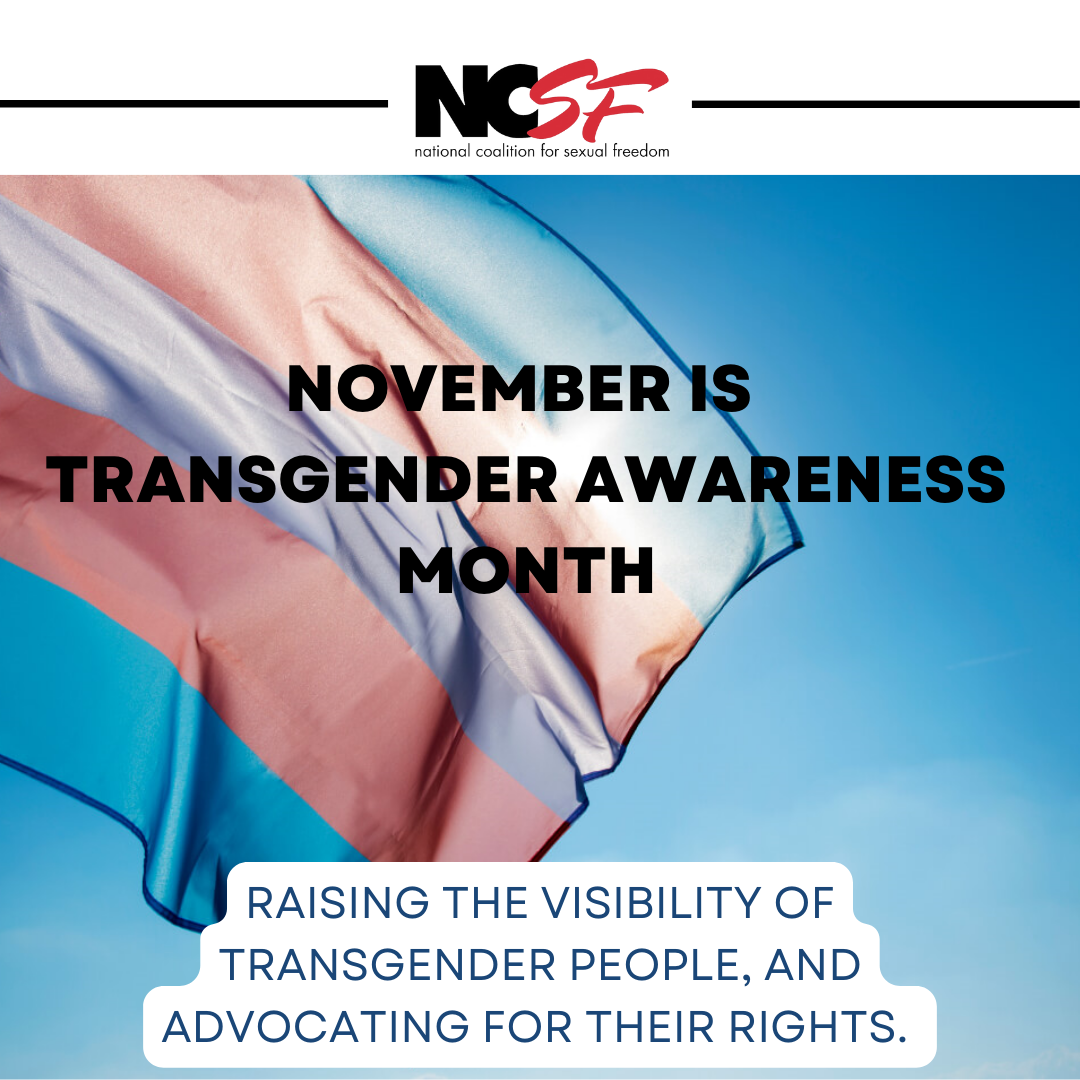
NCSF Asks Laura A. Jacobs: What would you like to see the Leather, kink, and polyamory communities do to support transgender awareness and transgender people?
How wonderful it sometimes is to be transgender or nonbinary! What exhilarating worlds are BDSM and polyamory! And how valuable allies become when they are well informed and compassionate!
This is what I’d want outsiders to know: we are not in the dungeon simply because we enjoy bondage or being spanked. We likely carry with us a history of emotional and physical trauma, inner turmoil, and a nuanced identity that may be difficult to explain. Sometimes we seek answers about ourselves and in other moments we simply want fun. We cannot – or might not always want to – articulate all this just to flog you. But if you are mindful and sympathetic, together we can delight in the ecstasy of smoking hot BDSM. You might even gain from the experience.
Being trans or nonbinary offers the privilege, for some of us, to study the most fundamental way in which humans classify others. Newborn infant? “Is it a boy or girl?” people ask, as though they could know its heart. That question is more truly an obsession with what lies underneath the diaper so they know what toys to gift.
Being trans is so often excruciating. The internal conflicts can consume our daily emotional capacity, a chronic toll that increases exponentially over time, while the physical, sexual, and emotional violence committed upon us are acute moments of trauma that leave us reeling. Families that are unwelcoming only compound the distress, while the impact of the vehement Christofascist minority’s mistruths and legislative attempts to eliminate our very existence is severe. No surprise that we curl up with our blankies sometimes. A few of us suffer so intensely that we shower in the dark, aware of the need for hygiene but unable to view our bodies, the sources of our torment.
Those of us with ‘trans feelings’ (whatever that may mean) have the opportunity to consider the nature of gender, how it relates to broader issues of identity, and even existential meaning. We are compelled to look within; we may hold inside a firmly known truth about ourselves as a different gender or we might be called to an open-ended exploration, but we endlessly speculate about why we have a sense of self that doesn’t align with the shell into which we were born. (Until we stop.) How is that even possible? We brood over the body/mind dichotomy and whether one or the other is more genuinely us, or if we are somehow both despite the contradiction. We endlessly debate nature versus nurture and whether the disparity is somehow the result of culture or a biological error in utero. We hyperfocus on genetics or seek answers from deities. We agonize over whether gender is a binary, a spectrum, or something multidimensional of shapes and hues that vary over time and which defies easy explanation. Who are we?
Trans people often spend years in psychotherapy following even more years of silent agony, only to still be left with decisions to make about how to act on our feelings.
Yet BDSM is an intentional fuck you to the compulsory identities and to the heteronormative, penis-in-vagina sex so often demanded by Western culture. Instead, BDSM centers intentional communication and thoughtful negotiation, establishing a world where we need not conform but in which we can enact ourselves and our sexualities in ways that are safe, affirming, and that bring us pleasure. It facilitates the exploration of gender and so much more, and can, at times, be healing. It is almost ideally suited for trans people.
Fundamentally, BDSM allows trans people to gain a control we too often don’t have otherwise. BDSM insists we verbalize clear boundaries about what ways we are to be touched, when and by whom, what we will or will not do, and how we are to be understood. It even compels us to stop an interaction if it becomes too threatening. There are countless reasons trans people might lack body autonomy, but here we can retake what was usurped by others.
For example: we may dissociate from our penises, breasts, and vulvae, either from dysphoria or as a result of sexual violence. But in BDSM we can experience pleasure through our backs and bellies. Or we can carefully guide genital contact that we can accept. Sensation play, impact play, and bondage also sidestep the locations of our distresses, making it possible to comfortably immerse ourselves within the endorphin rush without the complication of dysphoria, possibly enabling us to become more fully embodied over time.
In a broader culture where we are regularly demeaned, the power dynamics of BDSM allow us to subvert systems of authority and to again assume a control we may lack in mainstream settings. We might mimic Western hierarchical structures through D/s or find ways to liberate ourselves from them; ultimately, we might actually gain confidence in our daily life.
With roleplay we can experiment with different identities. We have the freedom of anonymity, presenting ourselves as the pirate captain or helpless maiden (of whatever gender) without reference to our everyday personas. We can experience being dominant if we otherwise feel weak or in service if we normally hyperfocus on what control we might have. We may eroticize gender directly in forced femme scenes, where those of us assigned male at birth cede control to a (generally female) Dominant who ‘coerces’ us to wear lipstick, stilettos, and a miniskirt; sometimes we are unable to grant ourselves permission, but the guise of submission makes it easier. What are those experiences like for us? What does it mean if we enjoy them? These provide both insight and thrill.
And we can even reframe our bodies in ways which align with our identities, whether or not we have undergone medical interventions. Sometimes humorously. Rather than penises, breasts, and vulvae, we might decide we have lollipops and trannyclits, cockpits, manholes, boycunts, chesticles, girlcocks, or aftermarket dicks. (Figure it out.) Instead of avoiding the body parts we have for fear of more pain, we may transform them so we can incorporate them with our affirmed gendered selves.
Consensual nonmonogamy, for those so inclined, structures sexual and romantic relationships in much the same ways and here again we often find safety in the clarity. It also allows trans people to enjoy a diversity of partners we may have lacked before.
And for some, BDSM and polyamory are acts of political resistance.
There is so much joy to be had. Don’t shy away because of our complexity but recognize that our trials help us develop strength and wisdom. Sometimes allow us the space we need to be without you, but gently gain our trust and we are often happy to share: our lessons about gender and life apply to you as well.
Revel with us. Have ecstasy with us. And together we can delight in the human experience.
BIO: Laura A. Jacobs LCSW-R (she/he/they/none), is a trans and genderqueer psychotherapist, public speaker, author, and activist specializing in transgender, nonbinary, LGBTQIA+, kink/BDSM, nonmonogamy, and sex work issues. Laura has authored/coauthored books, chapters, and articles, and their new book, Surviving Transphobia, was just released September 21, 2023. They served as the first transgender Chair of the Callen-Lorde Community Health Center. Laura was presented the 2019 Standard of Excellence Award by the American Association for Sexuality Education, Counseling, and Therapy and several others. Earlier in life, she worked as a musician, composer, photographer, and in less glamorous corporate middle management. She currently identifies (primarily) as a lesbian s-type in search of her female M or D.