
Huffington Post
…
I soon received an email from Rebecca Nagle from FORCE: Upsetting Rape Culture, a feminist activism effort that promotes awareness about rape culture, informing me that Pink Loves Consent is not an official Victoria’s Secret PINK line, but rather an effort by FORCE to promote awareness about rape culture.
Even though I was disappointed that Victoria’s Secret wasn’t actually promoting this positive image, I was very happy to realize that I had been tricked. I was so impressed that an activist group was able to reach so many people and garner such a positive reaction to a campaign that has to do with women’s bodies and sexuality. After an election year in which women’s bodies became a figurative stage for what has now been dubbed a “War On Women,” it was really encouraging to see women successfully reaching out to other women about how our culture’s perception of female sexuality must change.
—
I got the opportunity to chat with Rebecca Nagle and Hannah Brancato (the duo behind FORCE) and ask them about the Pink Loves Consent campaign:
How did the Pink Loves Consent campaign start?
Nagle: Upsetting Rape Culture actually started as an art exhibition in Baltimore in 2010. After we did that, we wanted to keep working, so the next thing we did is we made a line of underwear called “Consent Is Sexy.” We came up with this three-pack of underwear with a set of “No” underwear, “Yes” underwear and “Maybe” underwear, which we thought was a cute way of wearing what you were in the mood for. About a month later, Victoria’s Secret came out with this underwear that said “Yes, No, Maybe,” but it was all on the same underwear. Instead of saying yes, no or maybe and “I get to decide about what happens to my body,” it’s like, yes, no, maybe, I don’t know.
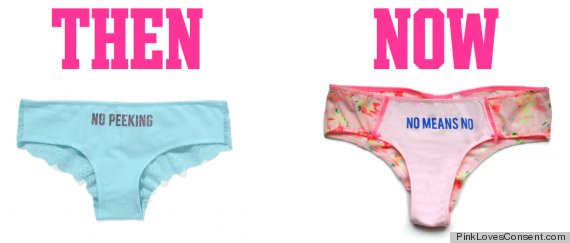
So instead of “No” being a way for young women to set a boundary, it is a way for them to flirt, which I think is part of this understanding we have in our culture that creates and perpetuates rape. So we were like, wow, this is crazy problematic. So the idea started to do a knock-off of Victoria’s Secret PINK line and we decided to time it with the fashion show.”
What is rape culture and do you think that VS/Pink promotes it?
Brancato: Rape Culture is all the things that allow rape to seem normal and prevent survivors from being able to speak up and out. Rape Culture is silencing. In a rape culture, people are surrounded with images, language, laws and other everyday phenomena that validate and perpetuate rape. It includes jokes, TV, music, advertising, legal jargon, laws, words and imagery, that make violence against women and sexual coercion seem so normal that people believe that rape is inevitable. Rather than viewing the culture of rape as a problem to change, people in a rape culture think about the persistence of rape as “just the way things are.”
PINK is specifically marketed towards younger and younger girls, and like the rest of Victoria’s Secret, PINK is selling a specific brand of sexuality. VS PINK has co-opted the idea of sexual freedom and twisted it into an image of sexuality in which the woman (or girl) is not really in control. The “Sure Thing” and “Yes, No, Maybe” and “NO peeking” underwear promote the idea of limitless availability, or on the other hand, leaving the choice up to the (presumably male) partner. The brand teaches girls to be coy instead of vocal and makes it seem uncool and unsexy to say no and mean it. By re-enforcing that sex is about an image, that looking good is more important than feeling good, PINK promotes rape culture.” …