
By Susan Wright, MA, NCSF Spokesperson
The prevalence of sexual choking has grown rapidly in the past several years among adults under the age of 40. In 2021, a campus-representative survey of over 4,200 University students found that most of the choking participants (88.9%) understand that people can die from being choked during sex, yet 37.5% said choking was safe and half (49.6%) reported that they knew how to engage in choking safely (Herbenick, 2024).
Pop culture articles promote this mistaken belief that there is a “safe way” to choke: of 69 articles published between 2007 and 2025 about sexual choking, 21 offered “how-to” advice on how to choke someone “safely.” Nearly one third (n=20) did not state that death is a potential risk from all forms of being choked, with another 13 stating that choking is “risky,” could cause “brain damage,” or it’s impossible to choke someone “safely” without mentioning the risk of death.
In July 2024, the National Coalition for Sexual Freedom (NCSF) conducted an email poll of our 50 Coalition Partner groups that serve kinky people. Only seven (12.3%) groups allowed choking at their events, with five of those groups (8.7%) allowing it only for certain members who requested permission from the monitors or owners. None of the groups provided workshops on how to choke someone, due to the liability risks.
Recent research has confirmed that cutting off the blood from the brain can potentially cause physical harm, such as brain damage or cardiac arrest (Dunn et al., 2023). Being choked can also cause harm to people’s mental health, including causing them to feel depressed, sad, lonely, and may cause anxiety (Herbenick et al., 2022). Repeated choking seems to compound these harms, increasing the risk of impairing your working memory for verbal and visual tasks (Hou et al., 2023a, 2023b; Huibregtse et al., 2022, 2025).
The risk of choking was confirmed by a recent paper, which found 88% (15 of the 17 cases) of accidental deaths during sexual activities were caused by sexual choking/strangulation (Schori, et al., 2022). Breath play instructions and CPR training were provided beforehand by three of the victims, which indicates that education and training cannot change the serious inherent risks of choking. Choking is the most dangerous sexual activity that people engage in (Sheff, 2021).
U.S. News Review of Choking Deaths
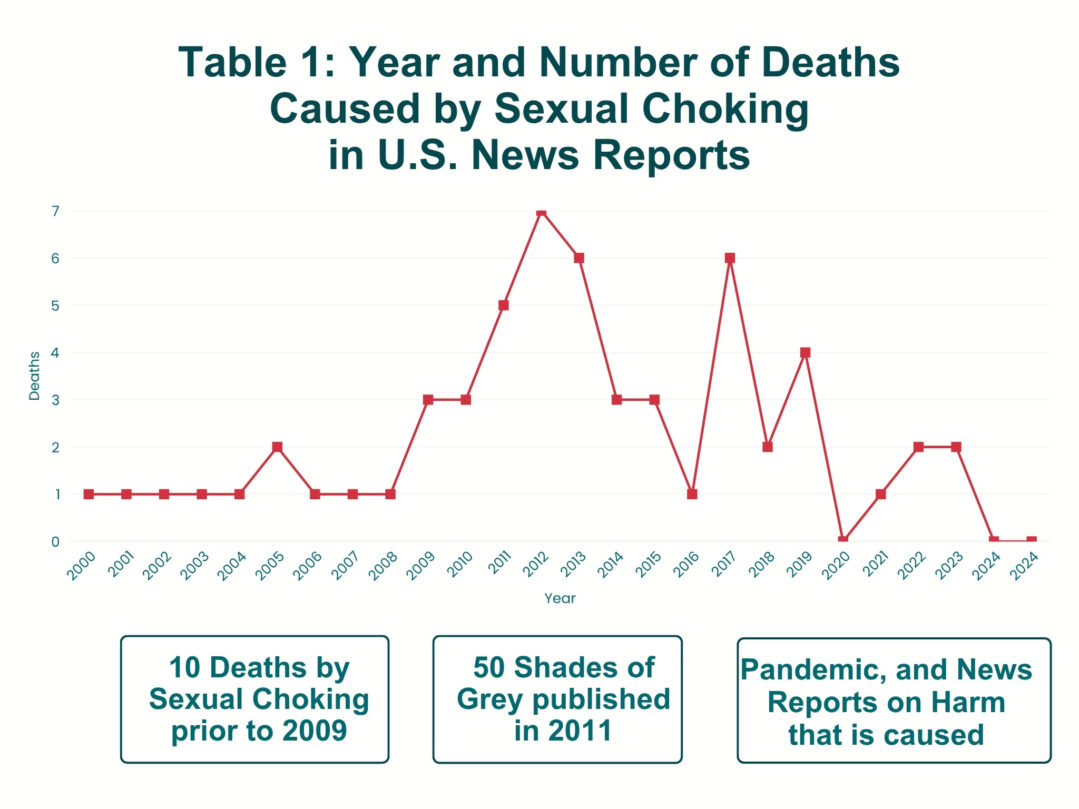
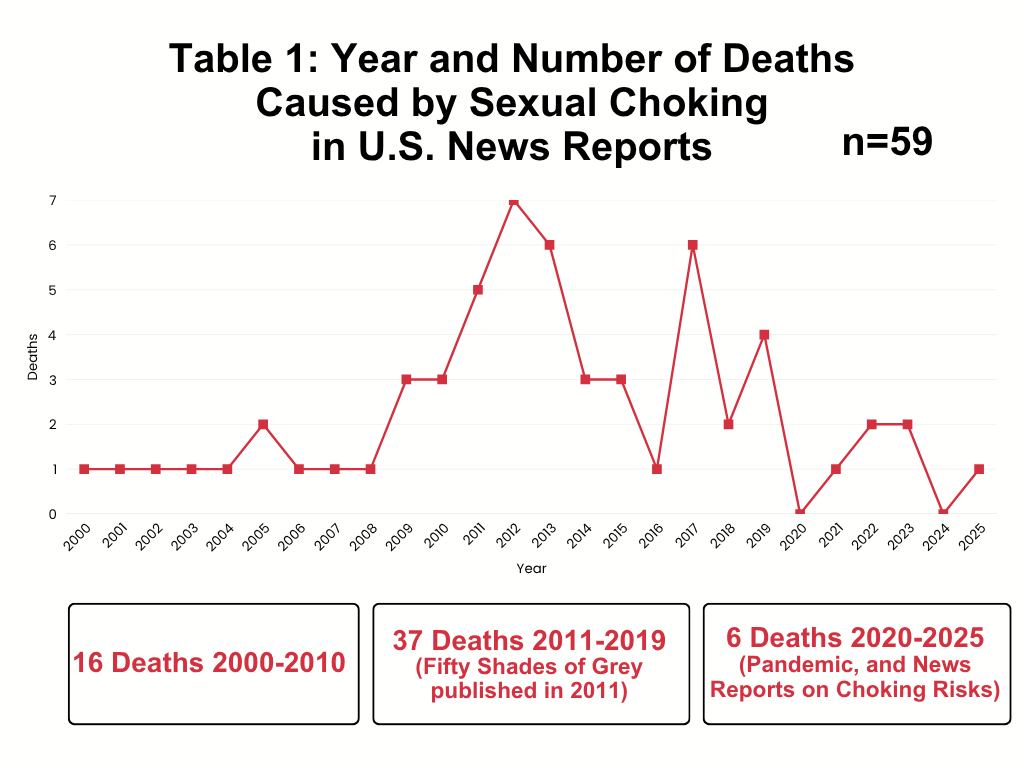
In order to confirm this finding, I conducted a review of U.S. news articles using Google and Bing “news searches” using the terms “+choking,” “+sex” and “+death.” This search found reports of 59 deaths between January 1, 2000 and December, 31 2025. The majority (63%, n=37) of these fatalities happened in a 10-year span occurring after the publication of the immensely popular Fifty Shades of Grey in June 2011, and before the pandemic. After 2020, new research data about the harms of sexual choking began making the mainstream news media. (Table 1)
Gender and Choking
A gendered pattern also emerges in this data, parallel to the research on choking, which has found that more men and gender diverse people, as compared to women, are choking their partners, while more women and gender diverse individuals, as compared to men, are being choked (Herbenick et al., 2023b; Herbenick et al., 2025; Sharman et al., 2025; Vilhjálmsdóttir & Forberg, 2023). In other words, women are more likely to be choked, while men are more likely to do the choking: 20.6% of the victims were male (n=12) while only 5% of the perpetrators were female (n=3).
In addition, nearly 14% of these cases involved apparently gay male/male partnerships (n=8), while the other 86% (n=51) involved apparently heterosexual male/female partnerships, with three of those involving a male perpetrator whose girlfriend was present when another woman was killed. Only one of the news reports indicated that a victim was possibly non-binary, identifying them as a “drag queen.” Because this analysis is based on media publications of cases, and some cases involving gender diverse or transgender individuals may have been neglected in publication, this low number of gender diverse / transgender people involved in the choking patterns may be a type of erasure. Research indicates that in addition to the previously mentioned gendered pattern of more women being choked and men choking, that there is also a pattern of more gender diverse / transgender people also being choked.
Additional Demographics
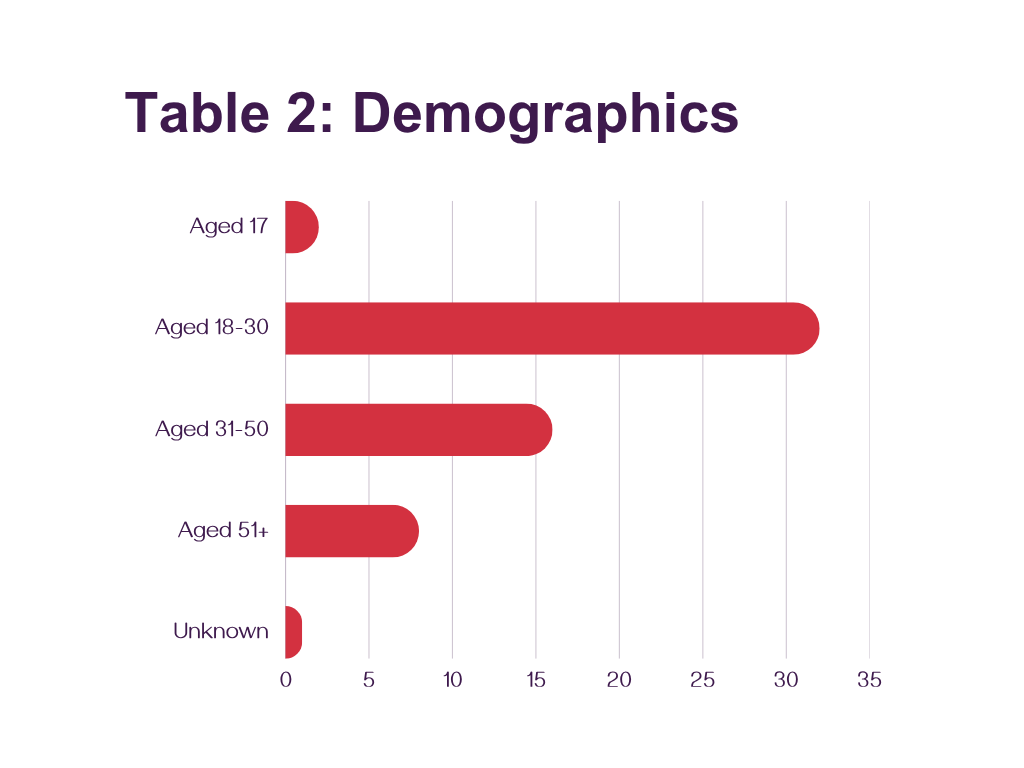
Over half of these victims (58%) were 17-30 years of age (n=34), while 27% were between 31-50 years of age (n=16), and 14% were older than 51 (n=8). Two of these victims were 17 years of age, and one was unknown. This finding is consistent with prior research that finds that choking is more common in adults in their 40s and below (Damiano et al., 2024; Döring et al., 2024; Herbenick et al., 2021; Herbenick et al., 2025; Sharman et al., 2024; Vilhjálmsdóttir& Forberg, 2023).
Nearly one-quarder of the deaths involved a girlfriend/boyfriend of the perpetrator (n=16), lovers (n=6), and play partners (n=2) (i.e. regularly engaging in BDSM together). By contrast, 7 of the victims engaged in choking on their first meeting with the perpetrator; in one case they had just met at a convenience store, in another they had just met on a dating app, and in another they had just met at a Halloween party. Other relationshships include: acquaintance (n=3), friend (n=3), sexworker client (n=3) and date (n=2).
According to the media reports, 20% of the deceseased (n=12) self-identified as engaging in erotic force or restraint, as did 27% of the perpetrators (n = 16). An additional 9 perpetrators stated that “he/she asked for it” as their consent defense; however, the articles provide no evidence that the victim was interested in sexual choking or erotic forces and restraint. Interestingly, this is consistent with emerging research that finds that large numbers of people engaging in choking do not self-identify as kinky, and with some engaging in this behavior because of an interest in “rough sex”.
The lack of mainstream access to kink education may have led to the current misconception that erotic choking is kinky. The 2015 US nationally representative survey, Sexual Diversity in America, found that while 30% of adults engage in spanking, 22% engage in roleplay, and 20% in bondage, only 3.4% have attended a BDSM party where they could learn about kink community norms such as safety issues and methods of communicating consent (Herbenick et al., 2017). One indicator that the education about the risks of choking has permeated the kink communities may be found in two of the NCSF Consent Surveys, which found only 2% and 3% of the respondents reported nonconsensual choking (Wright et al., 2015; Wright et al., 2022).
Legality of Choking
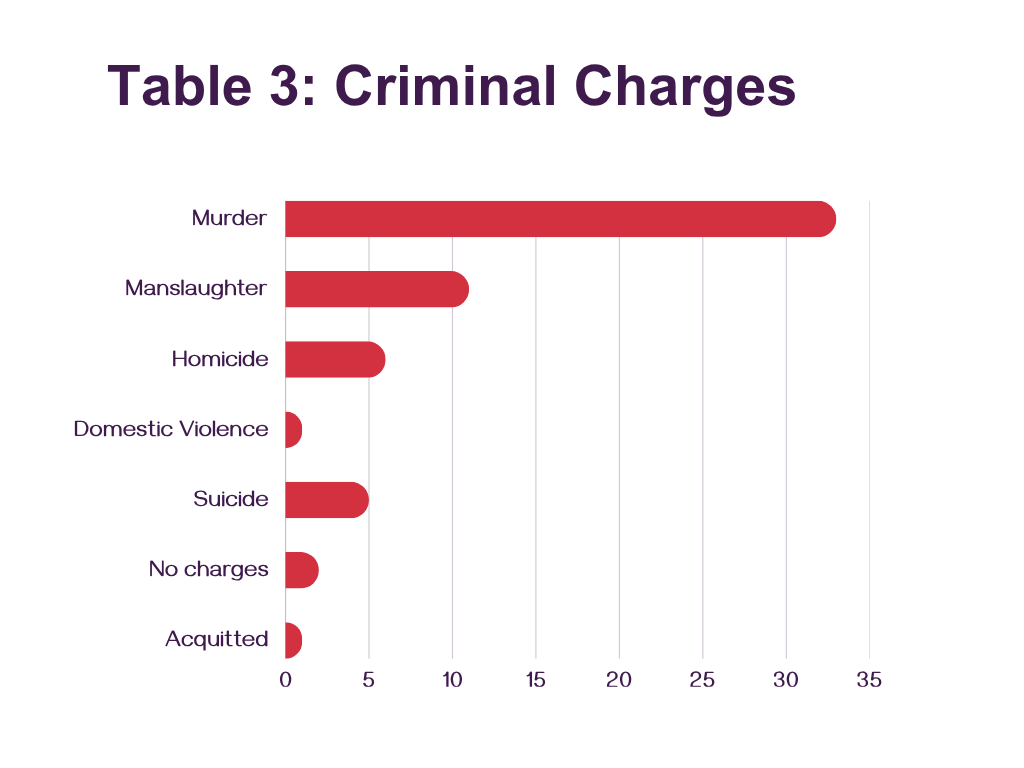
Consent is not a defense if you kill someone during sexual activity or cause them serious injury. In 51 of these deaths, the person who choked the victim was convicted of a crime such as murder (n=33), manslaughter (n=11), homicide (n=6), or domestic violence (n=1) (Table 3). 5 of the perpetrators committed suicide. 2 perpetrators were not charged with a crime, while 1 perpetrator was acquitted.
Current research has found that sexual choking is an ultrahazardous activity that can cause death and serious injury. No other sexual activity comes close to the risk involved in choking, and even if someone agrees to be choked, the person choking them will be held accountable by law if any harm is done. Moreover, there are several points of difference between consensual, legal kink activities and choking, including the risk of unconsciousness from choking resulting in the inability to withdraw consent, and a lack of informed consent, and in many cases, a lack of any discussion before engagin in choking.
The links to the News articles can be found on a Google spreadsheet that will be updated as needed.
The links to the Pop Culture articles can be found on a Google spreadsheet that will be updated as needed.
References:
Döring, N., Mohseni, M. R., Pietras, L., Dekker, A., & Briken, P. (2024). Research in brief: How prevalent is rough sex? Results from a national online sample of adults in Germany. Perspectives on Sexual and Reproductive Health, 10.1111/psrh.12267. Advance online publication. https://doi.org/10.1111/psrh.12267
Daminato, L., Riboli, G., Nese, M., Brighetti, G., Giunti, D., & Borlimi, R. (2024). How Italians transgress: A survey on rough sexual behaviors in a sample of Italians. Sexes, 5(2), 58-70. https://doi.org/10.3390/sexes5020005
Dunn R.J., Sukhija K., Lopez R.A. Strangulation injuries. [Updated 2023 Apr 22]. In: StatPearls [Internet]. Treasure Island (FL): StatPearls Publishing; 2025 Jan-. Available from: https://www.ncbi.nlm.nih.gov/books/NBK459192/
Herbenick, D., Fu, T. C., Carver, D. N., Brandenburg, D., Balle, M., & Eastman-Mueller, H. (2025). Prevalence and correlates of sexual choking and consensual non-consent (CNC) among college students: Findings from a campus-representative survey. Journal of Sex and Marital Therapy, 1–19. Advance online publication. https://doi.org/10.1080/0092623X.2025.2458173
Herbenick, D., Fu, Tc., Miller, O. Perry, C. P., Wright, P. J., Green, H. D., & Eastman-Mueller, H. (2024). Sources of learning about sexual choking and their associations with perceived safety and risk: Findings from a U.S. college campus-representative survey. Sexual Research and Social Policy, Advanced Online Publication. https://doi.org/10.1007/s13178-024-01072-6
Herbenick, D., Patterson, C., Wright, P. J., Kawata, K., & Fu, T. C. (2023b). Sexual choking/strangulation during sex: A Review of the literature. Current Sexual Health Reports, 15(4), 253-260. https://doi.org/10.1007/s11930-023-00373-y
Herbenick, D., Fu, T. C., Kawata, K., Eastman-Mueller, H., Guerra-Reyes, L., Rosenberg, M., & Valdivia, D. S. (2022). Non-fatal strangulation/choking during sex and its associations with Mental health: Findings from an undergraduate probability survey. Journal of Sex and Marital Therapy, 48(3), 238–250. https://doi.org/10.1080/0092623X.2021.1985025
Herbenick, D., Patterson, C., Beckmeyer, J., Gonzalez, Y. R. R., Luetke, M., Guerra-Reyes, L., Eastman-Mueller, H., Valdivia, D. S., & Rosenberg, M. (2021). Diverse sexual behaviors in undergraduate students: Findings from a campus probability survey. The Journal of Sexual Medicine, 18(6), 1024–1041. https://doi.org/10.1016/j.jsxm.2021.03.006
Herbenick, D., Bowling, J., Fu, T. C., Dodge, B., Guerra-Reyes, L., & Sanders, S. (2017). Sexual diversity in the United States: Results from a nationally representative probability sample of adult women and men. PLOS One, 12(7), e0181198. https://doi.org/10.1371/journal.pone.0181198
Hou, J., Huibregtse, M. E., Alexander, I. L., Klemsz, L. M., Fu, T.-C., Rosenberg, M., Fortenberry, J. D., Herbenick, D., & Kawata, K. (2023a). Structural brain morphology in young adult women who have been choked/strangled during sex: A whole-brain surface morphometry study. Brain and Behavior, 00, e3160. https://doi.org/10.1002/brb3.3160
Hou, J., Huibregtse, M. E., Alexander, I. L., Klemsz, L. M., Fu, T. C., Fortenberry, J. D., Herbenick, D., & Kawata, K. (2023b). Association of frequent sexual choking/strangulation with neurophysiological responses: A pilot resting-state fMRI study. Journal of Neurotrauma, 40(13-14), 1339–1351. https://doi.org/10.1089/neu.2022.0146
Huibregtse, M. E., Alexander, I. L., Klemsz, L. M., Fu, T. C., Fortenberry, J. D., Herbenick, D., & Kawata, K. (2022). Frequent and recent non-fatal strangulation/choking during sex and its association with fMRI activation during working memory tasks. Frontiers in Behavioral Neuroscience, 16, 881678. https://doi.org/10.3389/fnbeh.2022.881678
Huibregtse, M. E., Alexander, I. L., Fu, T. C., Klemsz, L. M., Rosenberg, M., Fortenberry, J. D., Herbenick, D., & Kawata, K. (2025). Association of blood biomarkers for neural injury with recent, frequent exposure to partnered sexual strangulation in young adult women. The Journal of Sexual Medicine, 22(5), 961-970. 10.1093/jsxmed/qdaf036
Schori, A., Jackowski, C. & Schön, C.A. (2022). How safe is BDSM? A literature review on fatal outcome in BDSM play. International Journal of Legal Medicine, 136(1), 287-295. https://doi.org/10.1007/s00414-021-02674-0
Sharman, L. S., Fitzgerald, R., & Douglas, H. (2025). Prevalence of sexual strangulation/choking among Australian 18–35 year-olds. Archives of Sexual Behavior, 54, 465-480. https://doi.org/10.1007/s10508-024-02937-y
Sharman, L. S., Fitzgerald, R., & Douglas, H. (2024). Strangulation during sex among undergraduate students in Australia: Toward understanding participation, harms, and education. Sexuality Research and Social Policy, 1–14. https://doi.org/10.1007/s13178-024-00941-4
Sheff, E. (2021). Kinky sex gone wrong: Legal prosecutions concerning consent, age play, and death via BDSM. Archives of Sexual Behavior, 50(3), 761-771. https://doi.org/10.1007/s10508-020-01866-w
Vilhjálmsdóttir, A., & Forberg, T. M. (2023). Sexual asphyxia: The state of choking during sex in Iceland. [Doctoral Dissertation]. Reykjavik University. http://hdl.handle.net/1946/44608
Wright S., Stambaugh R. J., Cox D. (2015). Consent violations survey: Tech report. National Coalition for Sexual Freedom. https://ncsfreedom.org/wp-content/uploads/2019/12/Consent-Violations-Survey.pdf
Wright, S., Bowling, J., McCabe, S., Benson, J. K., Stambaugh, R., & Cramer, R. J. (2022). Sexual violence and nonconsensual experiences among alt-sex communities’ members. Journal of Interpersonal Violence, 37(23-24), NP21800–NP21825. https://doi.org/10.1177/08862605211062999